


That idea eventually evolved into ROLR and its first product, the M1. The goal wasn’t to reinvent the wheel, but to make one that rolls better. ROLR’s philosophy revolves around doing a few things exceptionally well instead of chasing feature lists. The M1 is the physical result of that mindset: a compact, purpose-built tool born from years of frustration and a desire to create something better. Now that it’s in hand, we get to see if it lives up to the vision behind it.

Pliers and Operation
First impressions mean a lot, and the M1 put a smile on my face as soon as I opened the package. I’ve carried a Knipex Cobra for a while because I sometimes need a dedicated pair of pliers. As a guy who helped start this site, I don’t always carry a multitool—sounds crazy, but most days a compact set of pliers and a driver cover the jobs I run into. So when I came across the M1, I was immediately interested. It promised the pliers I already rely on but with some multipurpose functionality added in, and it had the potential to lighten my carry while freeing up pocket space.

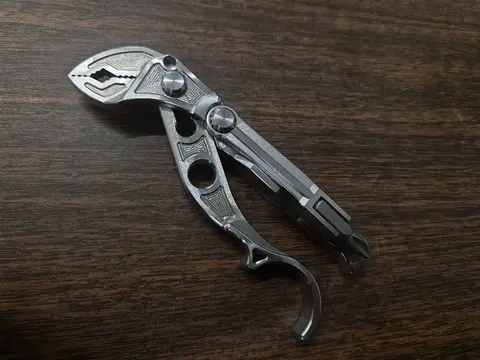
Right out of the box the M1 impressed me because it gleams. The tool is machined from 303 stainless steel with no coating or surface treatment, giving it a kind of jewelry-like appeal. We’ve seen tools that looked the part before (looking at you, Tread) but didn’t hold up in actual use. The visible milling lines are a neat touch and not something you often see, mostly because so many tools are cast instead of CNC machined.
The M1 is the same size as the Knipex Cobra but comes with several upgrades. The plier adjustment uses a slip-joint setup, or what ROLR calls a two-position system. This lets you grab tiny items with accuracy or open the jaws wide enough for a large nut or piece of pipe. The teeth aren’t as fine as the Cobras, but they’ve done well with everything I’ve thrown at them. The control arm has a comfortable arc with a scoop for your pinky or ring finger, making operation surprisingly comfortable even under pressure.
Switching between the two plier positions feels intuitive. You can move the head manually, or you can do what I do: hold the tool upside down with the arm extended and let gravity drop the jaws into the second notch. Flipping it back is just as easy. I’ll admit this has turned into a bit of a fidget habit. It’s oddly satisfying.

Driver and Pry Bar
The onboard tools sit tucked into the sides of the M1 and are easy to deploy. The arms and plier pivot are secured with tamper-resistant connectors, which makes sense considering how people in our community love to tinker. They look good, too, matching the tool’s design language.
One side of the handle holds a fold-out 1/4-inch bit driver with a magnet to keep bits in place. It rotates 45 degrees away from the body to get into position. There’s no lock or spring to keep it planted, so you’ll have to use your grip to stabilize it. I’ve put respectable torque on it and it’s held up fine.

The opposite side hosts the pry bar. You can use it as a flat driver in a pinch, though that’s not its intended role. A pry tool can be incredibly handy—there are plenty of times where you need to wedge, scrape, or separate something. Before pry bars became popular, people used their knives, which led to snapped tips or chipped blades. Others, myself included, reached for a flat screwdriver or whatever was lying around.

This pry bar isn’t as thin at the tip as I’d like, so it’s not going to slide under delicate surfaces. Since it’s the same 303 stainless as the rest of the tool, it’s strong enough for casual prying but can bend if you get too aggressive. Treat it kindly and it’ll last.

How It All Comes Together
Everything on the M1 stays in place thanks to N52 neodymium magnets. These aren’t the weak fridge magnets you slap kids’ drawings under—they’re strong, reliable, and long-lived. The magnets on both sides of the tool line up and give a nice pull when closing, almost snapping each part into place. That reassuring closure means I can drop it in my pocket without worrying about anything opening unexpectedly.
Because of the added tools, the M1 has a thicker spine. That actually works in its favor. It fills my hand better when I’m using the pliers and gives me more mass to grip. Comfort makes or breaks a tool for me. If it feels good in hand, I keep reaching for it. If it’s awkward, it stays in a drawer.

Closing Thoughts
The ROLR M1 is a unique tool in a sea of sameness. Multitools keep evolving but a lot of them recycle the same ideas every year. The M1 breaks that pattern. It’s refreshing to see something that isn’t trying to be everything at once, but instead focuses on doing its core jobs well. I appreciate the passion behind it, and from what I’ve been told, the M1 is just the start—there’s more on the horizon.
If you’re looking for a compact pair of pliers with meaningful upgrades and some thoughtful extras built in, the M1 from ROLR is worth checking out.
Specifications
Model: M1 – Gen 1
Material: 303 Stainless Steel
Construction: CNC machined from billet
Pliers: 2-position adjustable
Bit Driver: Fold-out 1/4 inch bit driver (magnetic retention)
Pry Bar: Fold-out, stainless steel
Magnetic System: N52 neodymium latch
Length: 4.2 in
Width: 0.45 in
Thickness: 0.3 in
Weight: 4.8 oz
Included Bit: #2 Phillips
Made in: USA
